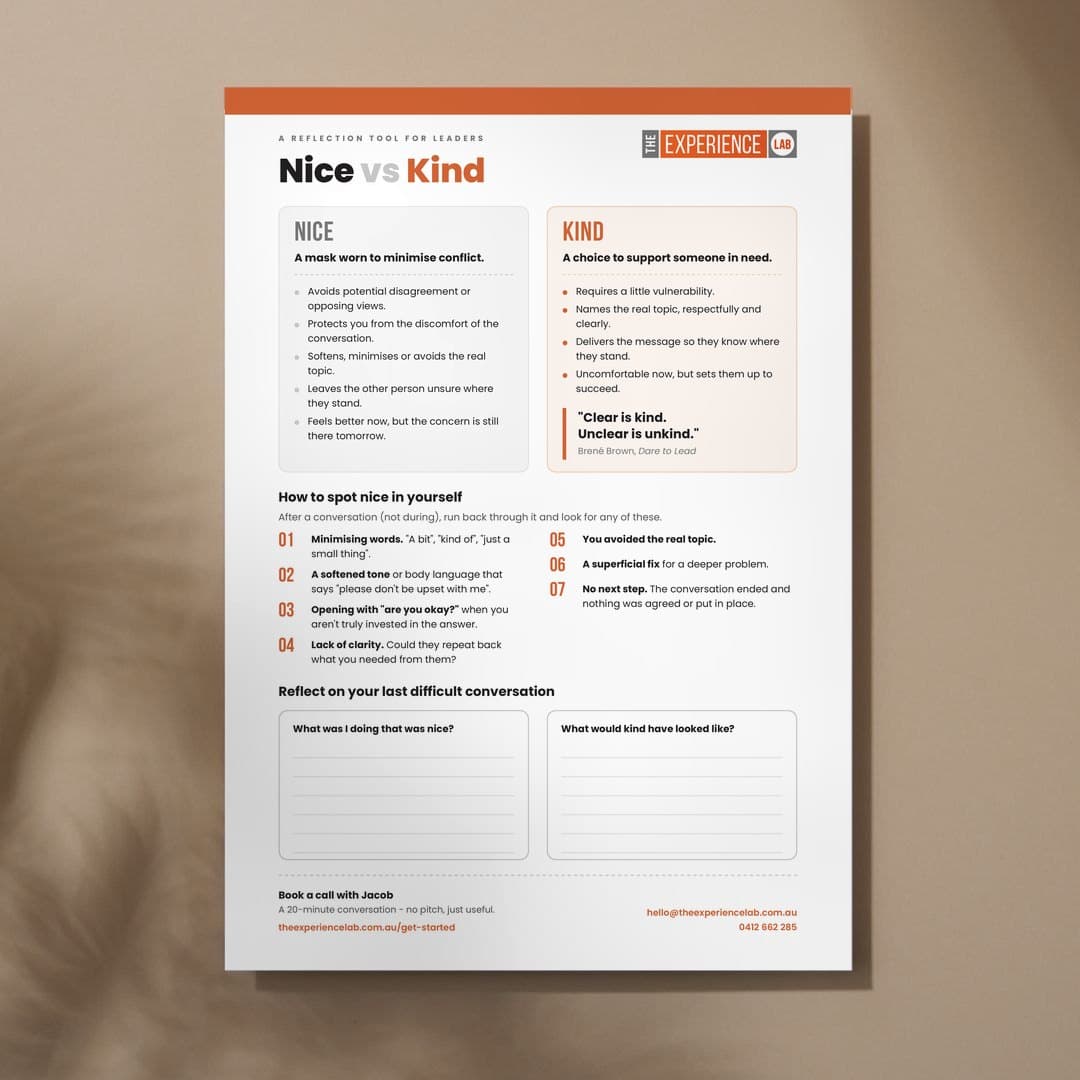
World Kindness Day is 13 November. This is a tool we use in practice conversations to separate nice from kind, and the resource you can use to reflect on your last conversation.
We wear ‘nice’ as a social mask to minimise conflict and make sure nobody is upset with us when we leave the room. Kind is an active choice to support someone, and in a work context will still get the message across, respectfully and clearly.
Nice protects both of us.
Kind shifts my comfortable conversation into one that is giving a clear picture of where they stand.
A teacher has a student who is likely to fail. Nice is “you're doing fine, keep at it.” Kind is “you're on track to fail this unit, and here is what you can do to change that.”
A colleague smells and people have started to avoid sitting near them. Nice is saying nothing and changing the seating plan. Kind is a word in private: “this is awkward, but I'd want to know if it was me.”
As Brené Brown puts it, “Clear is kind. Unclear is unkind.” When we are vague under the guise of kindness, we are usually managing our own discomfort, not theirs. Scale that up to a team and you get what Patrick Lencioni calls artificial harmony: everyone agrees in the meeting and the real conversation happens in the corridors.
We adopted this for a leadership program and it has followed us into many supervisor practice sessions since. When we include it in a program we don't employ it while the conversation or demonstration is happening. We use it as a debrief tool. A participant sits across from one of our RealPlay actors who portrays a colleague, they practise the conversation they've been avoiding, then we stop and reflect together. If the outcome is “the supervisor likes them” and there's nothing discussed about standards, behaviours or being clear about expectations, that conversation was nice.
Many of the cues we see across our Courageous Conversations work are present:
- Minimising words: a bit, kind of, just a small thing.
- An incongruent tone, where the words say this matters and the voice says don't worry about it.
- The feedback raised as a question when it needs to be a statement. An apology for bringing it up.
- The issue delivered in jest so it can be taken back if it’s received badly.
- A focus on reassurance with the concern hidden in the middle.
- Speaking for the group (“some people have mentioned”) instead of for yourself.
- Agreement with whatever reason is offered.
- A “catch up” booked instead of the discussion topic clearly communicated.
We need to be kind when we’re having conversations with a consequence: someone's performance, their behaviour, their safety.
The rest of the day can be low stakes.
Use our handout to review your last difficult conversation.